Blast Off Into History: Why Artemis II is the Mission You Can’t Miss
- March 30, 2026
- By Thom Smith
“You hear about the Artemis II mission?” – This is the text my oldest son sent me recently. What was my sad response? “No, what’s going on?”
I find my reply to be tragic for three reasons:
- I’m in the middle of teaching an astronomy unit to my fifth graders and I wasn’t aware of Artemis II until my son mentioned it to me!
- I’m in my 15th year of teaching astronomy, and I wasn’t aware of Artemis II until my son mentioned it to me!
- I’m living in the height of the digital age, bombarded by information, and I wasn’t aware of the Artemis II until my son mentioned it to me!
So, have you heard about the Artemis II mission? Now that we are coming closer to the launch date (tentatively scheduled for April 1st, 6:24 PM), perhaps you have! Or maybe you haven’t. And if you have, how much do you know about it? Well, no worries, because this article is for you, your students, and anyone else who might be curious about this latest blast off into space!
Why Teach About Artemis II
- Artemis II is a major current event – It wasn’t that long ago when any form of space travel was front page, headline news. So what happened? Has space travel lost its luster? Is it so commonplace now that it doesn’t warrant attention? I mean, after all, our pop stars are making it to outer space! Whatever the reason for lack of attention, our world should sit up and take notice of Artemis II. It is an important current event for several reasons, and it is important to teach current events to our students.
- Christina Milotte, NASA Education Specialist, offered an interesting perspective on this shift. She explained, “Space exploration is still the “showy” part of NASA. It excites people and allows NASA to keep the vital missions going that monitor the health of Earth.” She reminded me that while rockets grab headlines, the majority of NASA’s work quietly tracks precipitation, ocean currents, ice cover, wildfires, and the many interconnected systems that keep our planet functioning.
- Artemis II will immediately impact our future – this mission will be the first step in getting humans back on the moon. And why is that important? Because the next lunar landings will lead to new discoveries, a sustainable human presence on the moon, and future space exploration beyond the moon, including trips to Mars!
- Milotte put it in beautifully simple terms: “The Moon is a practice for Mars exploration.” The moon isn’t the final destination – it’s the training ground!
- Artemis II aligns with our Next Generation Science Standards (NGSS) – Studying and following the Artemis II mission can open up all types of science lessons that directly connect to the NGSS at all age levels, such as:
- Learning how forces like gravity and motion affect the rocket and spacecraft
- Exploring how the Sun, Moon, and Earth interact
- Learning about push and pull forces
- Learning how NASA (and other space agencies) design solutions to problems
- Engineering analysis of spacecraft systems, risk mitigation, and testing protocols
- Ethical and societal discussions on human space exploration
And if teachers are wondering whether it is worth carving out time in an already packed schedule, Milotte emphasized the incredible science connection: “Artemis II comprises a variety of science missions, many of which are dedicated to studying astronaut health in space, including the effects of space weather.”
Space weather opens doors to discussions about the solar wind, magnetic fields, radiation, and even why Mars may have lost its atmosphere. Suddenly, a rocket launch becomes a gateway into plasma physics, planetary science, and Earth’s own protective systems.
The Five W’s (and the How) of Artemis II
Back to the question I texted my son – “What is going on?” Here are the basics of the “Five W’s” and the “How” of Artemis II:
- “The Whos”
- The Organizations:
- NASA – The National Aeronautics and Space Administration (NASA) created and leads the Artemis II mission. NASA manages the Space Launch System (SLS) Rocket and the Orion spacecraft development.
- CSA – The Canadian Space Agency (CSA) contributed to robotics systems of the mission.
- ESA – The European Space Agency (ESA) developed the European Service Module (ESM) which provides power, propulsion, and life support.
- Lockheed Martin – Lockheed Martin is the prime contractor for the Orion Crew Capsule.
- The Astronauts:
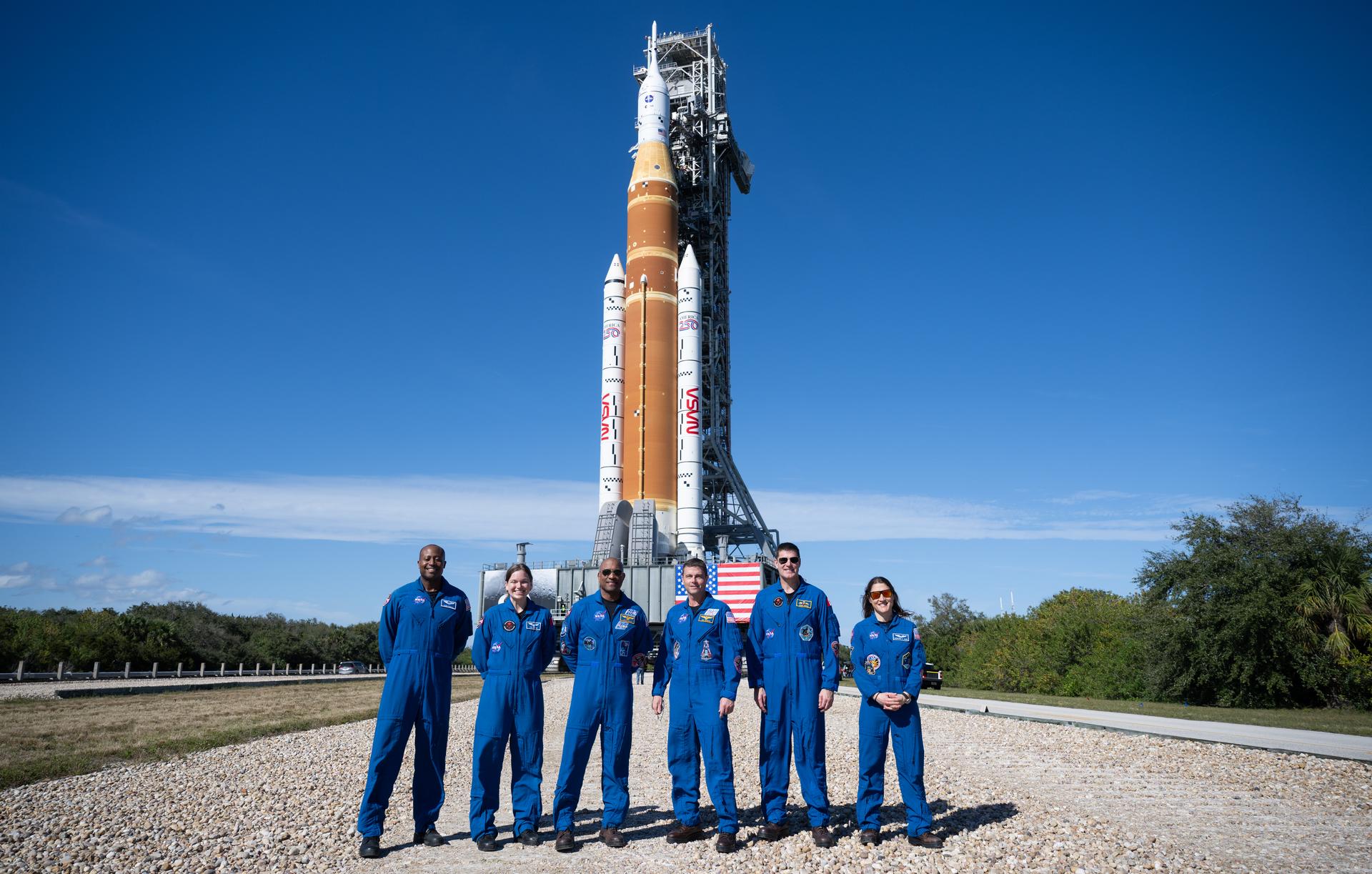
- Reid Wiseman – Commander of the Artemis II mission.
- Victor Glover – Pilot of the Artemis II mission.
- Christina Koch – Mission specialist of the Artemiss II mission.
- Jeremy Hansen – Mission specialist (from the CSA) of the Artemis II mission.
- The Organizations:
- “The What”
- Artemis II is the first crewed mission of NASA’s Artemis lunar program. Artemis I, the first mission of the lunar program, was an uncrewed flight test in November 2022 of the SLS rocket and Orion spacecraft. For Artemis II, humans are going to fly around the moon and back to test all the systems and gear astronauts will need for future missions – where humans will set foot on the moon again.
- The Artemis lunar program is named after the goddess of the moon, Artemis, from Greek mythology. Her twin brother, the Greek god Apollo, was the name of the first series of crewed spaceflights to the moon in the late 1960’s and early 1970’s.
- “The When”
- Artemis II is currently scheduled to launch no later than April 2026. The mission itself will last about ten days.
- “The Where”
- The adventure begins at NASA’s Kennedy Space Center in Florida where the astronauts will launch aboard the powerful Space Launch System (SLS) rocket. After liftoff, the astronauts will travel around the moon, far beyond the lunar orbit, and then return to Earth.
- “The Why”
- This isn’t just an out-of-this-world space trip, although it is “straight fire”! There are three major reasons for this mission:
- It helps NASA test that the spacecraft (Orion and the SLS rocket) can support humans in deep space.
- It’s a stepping stone toward future lunar landings, a sustainable human presence on the moon, and preparation for sending astronauts to Mars.
- Data from the mission will help scientists understand how space travel affects astronauts, which is critical for future trips to the moon and beyond.
- When we talk about going beyond the moon, the scale becomes staggering. Milotte shared what excites her most about this era of exploration: “I think what really excites me about the Artemis era is the prospect of the human exploration of Mars…it is a minimum of seven months, one way…at least a three year mission.” Suddenly, students aren’t just learning about rockets. They’re thinking about resource management, oxygen production, teamwork, and survival on another world!
- This isn’t just an out-of-this-world space trip, although it is “straight fire”! There are three major reasons for this mission:
- “The How”
- The astronauts will launch on the SLS rocket with the help of 8.8 million pounds of thrust! It is the most powerful rocket NASA has ever built.
- Astronauts ride in the Orion spacecraft, which is designed to keep them safe far from Earth.
- Once Orion gets past Earth, the spacecraft will carry them all away around the moon so they can test life-support systems, navigation, communication, and other critical systems in real space conditions.
- After flying around the Moon, Orion will swing back to Earth and bring the crew home safely by splashing down in the Pacific Ocean, off the coast of San Diego, California.
Record-Setting Artemis II Mission Stats
The Artemis II mission and its crew are going to set numerous historical records after they’ve splashed down into the Pacific:
- First crewed mission beyond Low Earth Orbit since Apollo 17 in 1972!
- Farthest humans from Earth – this mission will take humans approximately 250,000 miles from Earth!
- First crewed flight of the Orion capsule and the SLS rocket!
- First non-American to travel around the moon – Jeremy Hansen!
- First woman to orbit the moon – Christina Koch!
- First person of color to travel to lunar distance – Victor Glover!
- First four-person lunar vicinity crew – the previous lunar missions had three!
- Highest speed for a crewed Earth-return reentry – about 25,000 mph!
- Most powerful rocket to ever launch humans – 8.8 million pounds of thrust!
- First crewed Artemis mission, of course!
Representation matters, too. Milotte spoke passionately about this saying, “As an educator, I feel that this is incredibly important. Children are inspired by people who look like them.” For many students watching this launch, they can see themselves reflected in the crew. That matters more than we sometimes realize.
How to Integrate Artemis II Into Your Lessons
I’m sure you and your colleagues could come up with a myriad of ways to introduce Artemis II to your students. The following activities are just a few ways you could integrate learning about Artemis II in the classroom:
Elementary Classroom:
- Students can track the rocket’s journey, imagine astronauts orbiting the Moon, and discuss how gravity affects motion. They could journal during the ten-day mission, and/or write poems about outer space and space travel.
- Simple hands-on activities like launching bottle rockets or building and flying paper airplanes can mirror real physics in a fun, safe way.
Middle School Classroom:
- Students can model Artemis II’s orbit, and/or simulate trajectories using software or physical models.
- Students can investigate how systems must work together (rocket, Orion capsule, astronaut life-support) for a safe mission.
- Students can discuss future lunar exploration, then design projects or create research presentations based on their discussions.
High School Classroom:
- Students can calculate orbit trajectories, energy requirements, and mission durations using NASA data.
- Students can analyze engineering trade-offs, such as fuel limits versus life-support systems.
- Students can engage in debates or research projects about human spaceflight, the Moon, Mars missions, and why exploring space matters for Earth and science.
Artemis II Resources
This article is a flyby of the Artemis II mission, barely scraping the surface of all the components that go into designing, constructing, preparing for, and launching the SLS rocket and Orion spacecraft (WITH HUMANS) into space! Hopefully you feel as though you have a good grasp of “what’s going on”, and are ready and excited to introduce Artemis II to your classroom!
And if there’s one final message to pass on to the students as countdown approaches, perhaps we borrow Milotte’s advice: “Look up!” Because sometimes inspiration begins with nothing more than lifting up your eyes to the skies!
For more information and resources for you, your colleagues, your students, and your students’ families, check out the following:
What Is the Artemis Program? (Grades K-4) – NASA
Join the Artemis Mission to the Moon – NASA
Moonbound | For All Humanity | NASA+
Artemis II to the Moon: Launch to Splashdown (NASA Mission Animation)
Preparing for Artemis II: Training for a Mission Around the Moon – NASA
Artemis II could take humans farther than they’ve ever gone before – 60 Minutes