What the EdTech Pushback Gets Right (And What It Misses)
- July 22, 2026
- By Ted Levine
You’ve probably noticed the mood around EdTech has changed. After a few years of rapid, pandemic-era buying, districts are now taking stock — auditing subscriptions, cutting what isn’t working, and setting clearer guardrails around screen time. Los Angeles Unified just approved a policy limiting or banning technology by grade level starting next school year. More than a dozen states have proposed or adopted screen-time restrictions. Senators have held hearings on it. Even Hollywood has weighed in. It’s a real reset, and a healthy one.
None of this should surprise anyone who was paying attention during the pandemic buying boom. School districts spent billions of dollars on software, much of it purchased in a hurry, without a clear plan for implementation, training, or measuring success. A lot of it sat unused, or was never purposefully implemented. Parents noticed their kids logging more hours in front of screens with little to show for it. Teachers, who were given little to no support to actually learn these tools, quietly stopped using half of what was purchased.
As educators, parents, and district leaders, you lived through this. And honestly? I think the pushback is fair. Where I’d push back a little is on the idea that the answer is simply less technology, full stop.
Here’s what I keep coming back to: It shouldn’t be screen time versus no screen time. It’s effective, purposeful learning versus passive, unmonitored use. A tool that replaces an expensive, hard-to-update analog resource, that delivers real content knowledge instead of just entertainment, and that a teacher can effectively implement into a lesson — that’s entirely different than an app kids open to kill twenty minutes. Districts shouldn’t have to choose between rigor and technology. They need tools that earn their place, and proof that those tools are actually working.
That word — proof — is where I think our industry has fallen short, and where districts are right to push the hardest. If a school buys a subscription, a principal or curriculum director should be able to answer some basic questions: Are teachers actually using this? Which grades and classrooms are engaged, and which aren’t? Is usage tied to the standards it was purchased to support?
If EdTech vendors sell a license, but disappear until renewal time, that’s not a partnership — it’s a transaction. That’s exactly the kind of relationship that’s fueling the skepticism we’re seeing right now.
But at Kids Discover, our North Star has always been getting kids excited about reading and learning — and for 35 years, that’s meant building science and social studies material that we’re genuinely proud of: factually rigorous, editorially independent, and designed to engage even the most reluctant readers. But great content isn’t enough anymore, and I’ve heard that loud and clear from teachers and district leaders alike. They don’t just want good material. They want to ensure it’s being used, and used effectively.
Introducing the Data Dashboard
That’s why, in the coming months, Kids Discover is rolling out a Data Dashboard that will give teachers, schools, and district administrators a clear, easy-to-read view into their Kids Discover Online usage. The dashboard will better unveil how classrooms and grades are engaging with the platform, and where implementation is thriving versus where it might need a nudge.
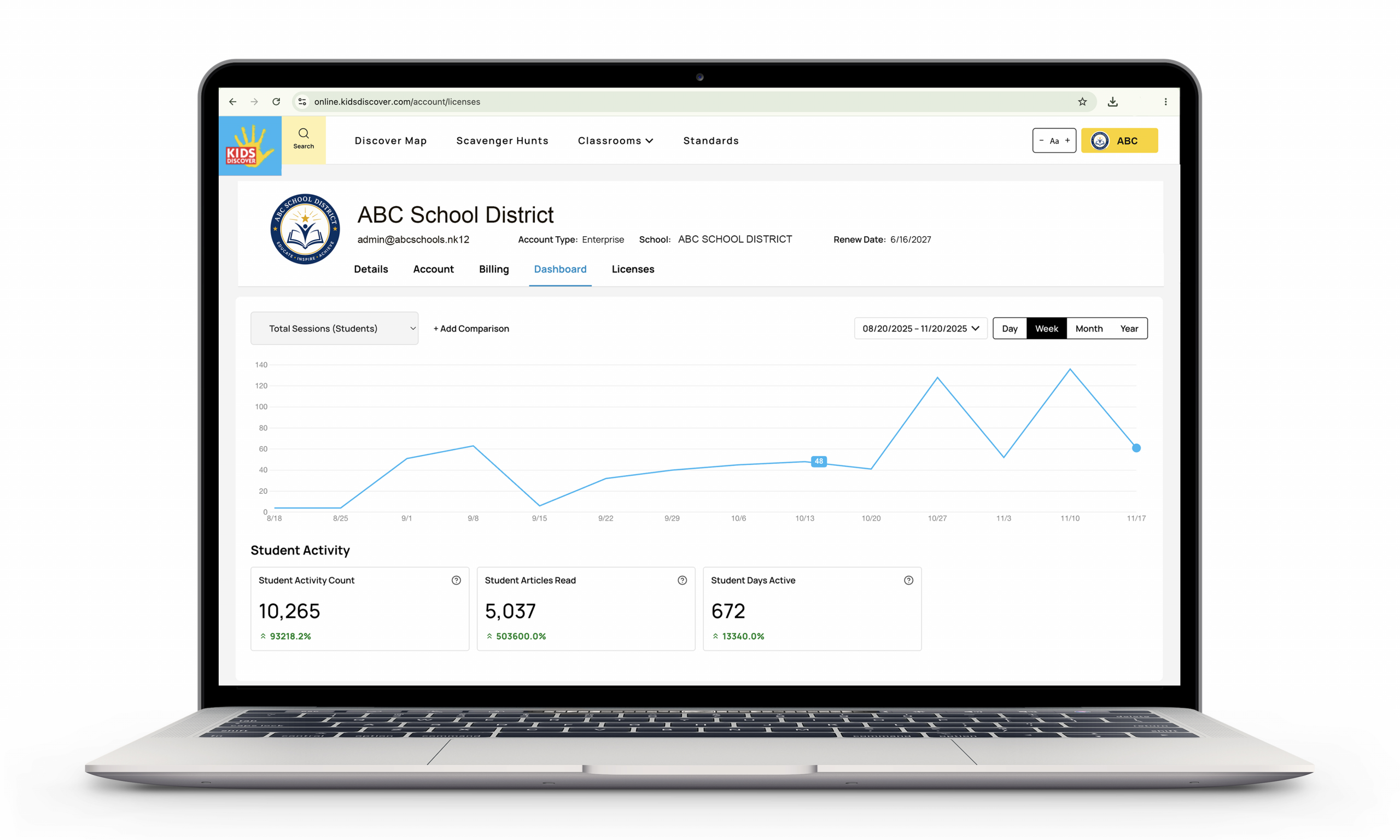
For us, this comes down to clarity. Districts and schools deserve the same insights into their EdTech investments that they’d expect from any other major purchase — a real, honest read on what’s working, what isn’t, and where there’s room to grow. That’s what the Data Dashboard is built to deliver.
In a moment when school communities are rightly asking harder questions about what EdTech is actually for, I’d rather answer those questions than avoid them. Effective, accessible content that saves money over analog alternatives, gets used the way it’s intended, and comes with the transparency to prove it — that’s the standard I think every EdTech product should be held to.
Access into this usage information is only half the picture. We’re pairing the Data Dashboard with the same hands-on customer service and account management our districts already count on, so that these insights actually translate into action — helping schools get the most value out of every Kids Discover Online subscription.
We’ll have more to share on this brand new feature in the coming weeks. In the meantime, if you’re a Kids Discover Online subscriber and you’re curious what this could look like for your school or district, reach out — we’d love to show you.